


Third-person
Scene dynamics, material interactions, motion, and state evolution across diverse physical scenes.

A Cross-Domain Benchmark for Physically Grounded Video Captioning
To our knowledge, the first unified physical-caption benchmark spanning all three domains: third-person scenes, egocentric manipulation, and handheld-gripper demonstrations.
Videos contain contact, motion, deformation, and recovery. A caption can name the activity and still leave these processes out. What physical information survives when video becomes language?
Born from world-model pretraining practice, PhysCapBench provides a common yardstick: human-verified physical references, seven evaluation dimensions, and downstream tests in generation and manipulation.
Task-level descriptions can name an activity while missing the physical process. PhysCapBench evaluates both accuracy and coverage of observable interactions.
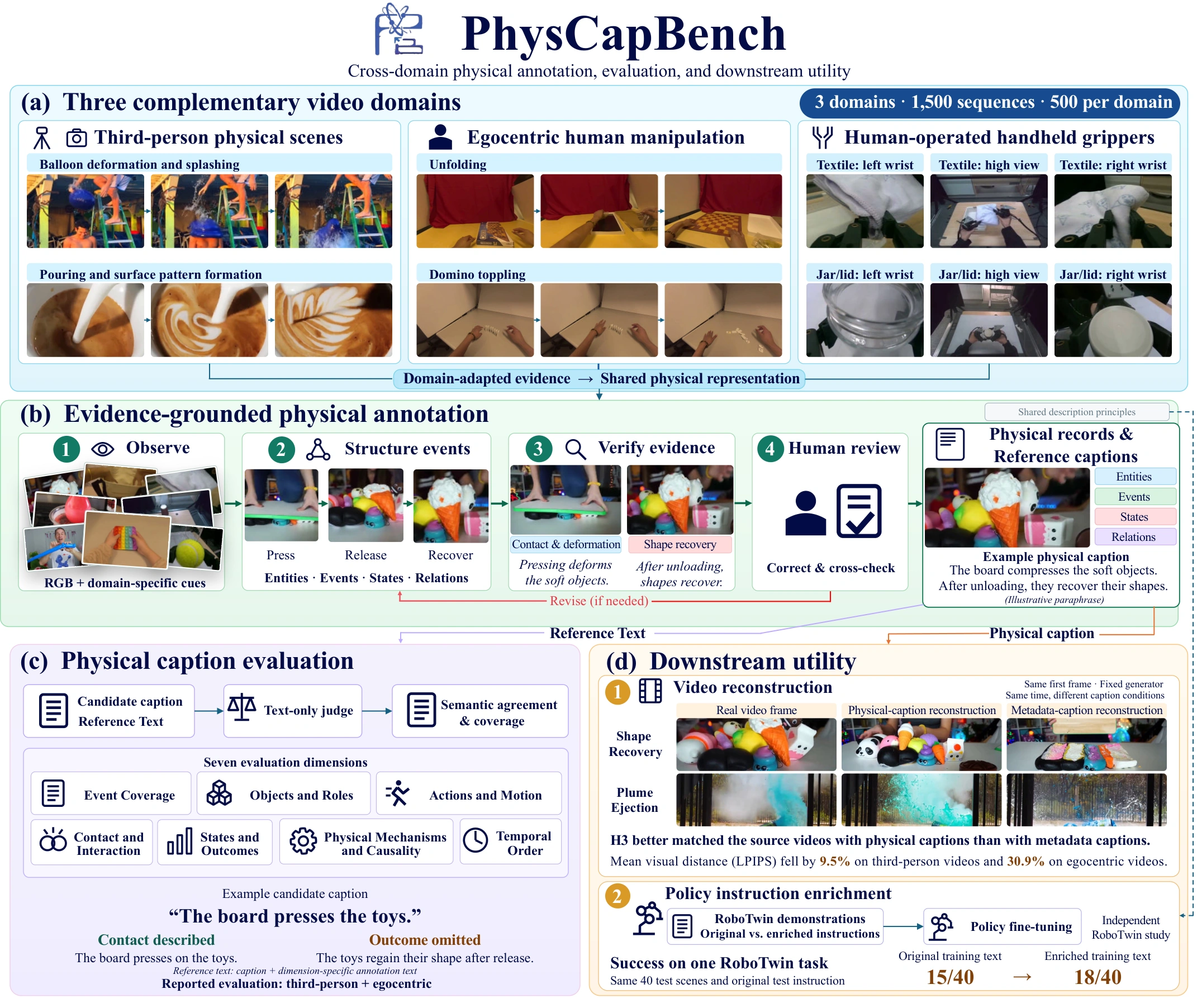
From scene-level dynamics to human and gripper manipulation, PhysCapBench brings 500 examples from each domain into one physical-description framework.
Three domains of reference data and annotation; current caption-strategy results cover third-person and egocentric videos. Handheld-gripper rankings will follow.
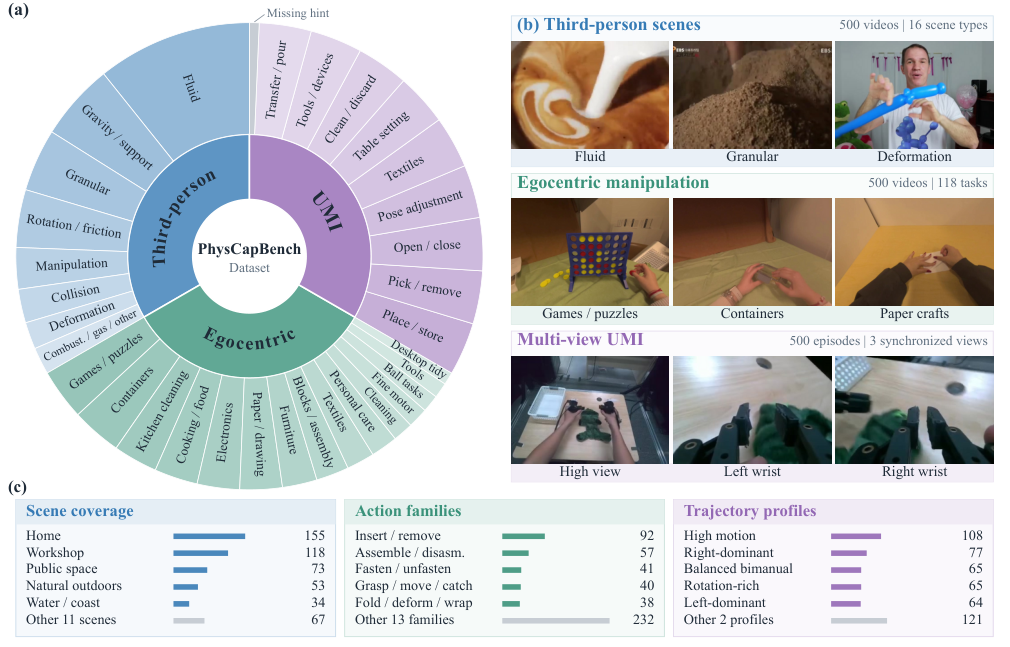
Scene dynamics, material interactions, motion, and state evolution across diverse physical scenes.
Human manipulation with explicit hand identities, object roles, and visible changes.
Human-operated demonstrations with synchronized viewpoints and trajectory cues for annotation.
Each domain contains 500 videos or demonstration episodes. Egocentric videos include paired hand tracking (approximately 2.21 hours in total); handheld-gripper episodes include synchronized high, left-wrist, and right-wrist views with gripper trajectories. Multiple camera views count as one episode.
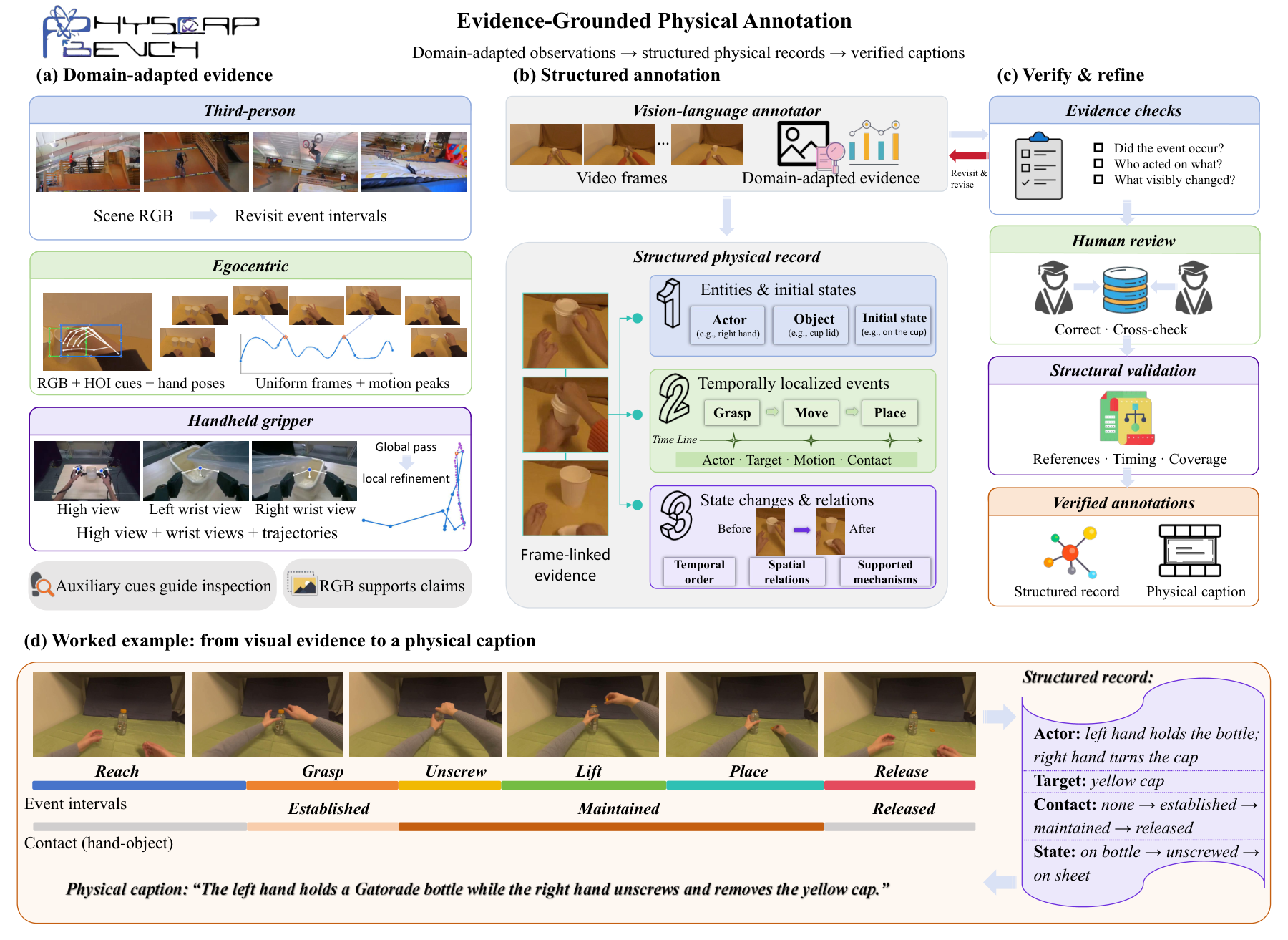
A time-localized interaction: who acts on what, how contact or motion changes, and what state remains afterward.
Inspect RGB frames. Hand motion, interaction cues, synchronized views, and gripper trajectories help identify changes worth revisiting.
Assign entity identities and roles. Record event intervals, motion, contact transitions, before-and-after states, and supported relations.
Revisit the source frames, correct unsupported details, and check identities, timing, and coverage. Seven professional annotators verify and cross-check the records.
Three perspectives. Every event in focus.
Are the important events retained?
Who acts, with which instrument, on what?
How do the participants move?
What touches, supports, grasps, or separates?
What changes, and what remains afterward?
Which mechanisms and causal links are supported?
Are sequence and overlapping events preserved?
Doubao Seed 2.1 Pro compares captions against fixed reference content at temperature 0, with thinking disabled. Scores measure semantic agreement and coverage on a 0–100 scale. Applicable dimensions are averaged per video; overall results average those per-video scores.
Captioning strategies evaluated across seven physical dimensions.
Egocentric captioning strategies evaluated against shared references. Overall scores are averaged per video over applicable dimensions; they are not the mean of the displayed dimension averages. Equal scores share the same rank.
The benchmark includes 500 handheld-gripper episodes.
The supplied report does not publish a caption-strategy leaderboard for this domain.
Caption scores locate missing information. Reconstruction and policy experiments test whether richer physical descriptions are useful downstream.
Physis vs. Meta overall score on egocentric videos: 79.36 vs. 42.41.
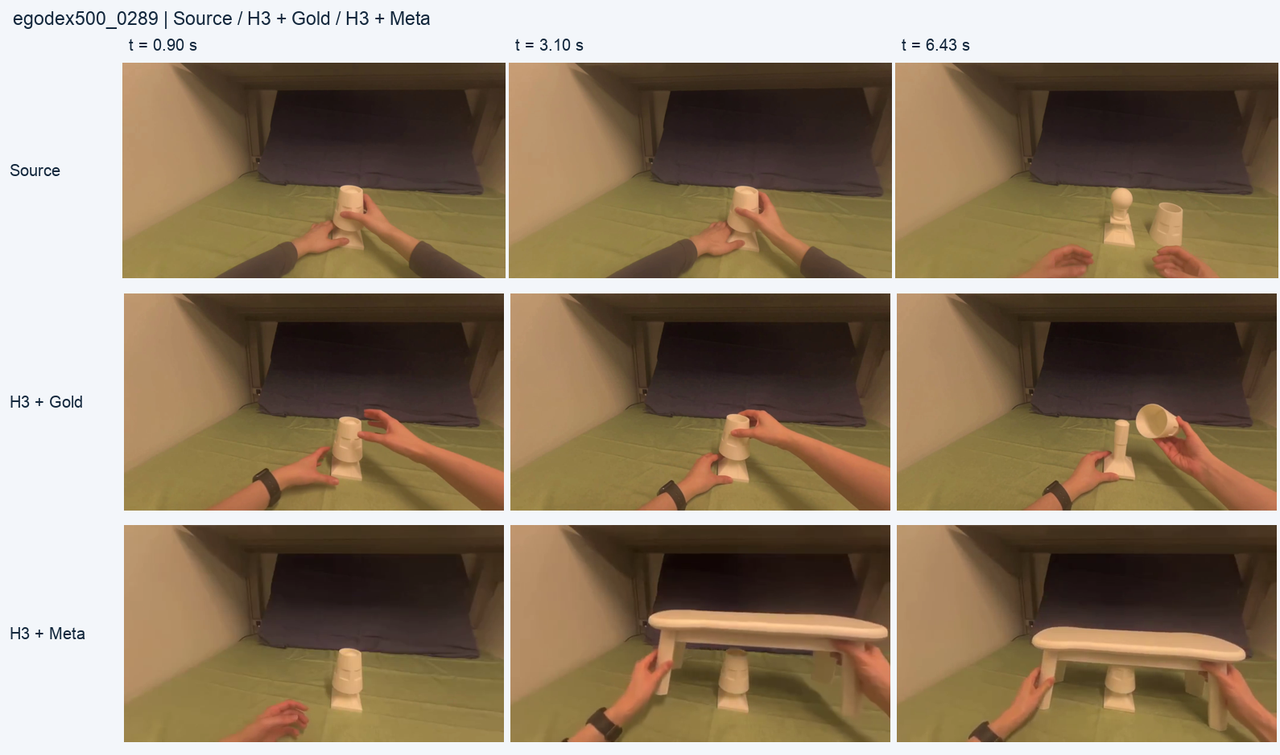
Lower LPIPS for H3 on egocentric videos with physical captions.
Single-task success: 37.5% → 45.0%, across 40 shared held-out scenes.
Compressing EgoVid Dense into EgoVid Action raises temporal-order scores from 63.75 to 67.50, while states and outcomes fall from 70.88 to 60.62. A single overall score would hide that trade-off.
Physis leads overall at 74.07 and tops five dimensions. LingBot Temporal leads temporal order (72.84), while Cosmos3 Narrative leads mechanisms and causality (71.00).
Physis leads overall at 79.36. Cosmos Ego leads contact and interaction (83.57) and temporal order (77.50). Different strategies retain different physical information.
The source shows soft toys compressed under a board, then recovering their volume. The physical caption includes recovery after unloading; the metadata caption ends with revealing deformed toys.
METADATA CAPTION · EXCERPT“then lifts the board to reveal the deformed toys”
PHYSICAL CAPTION · EXCERPT“The group of soft rubber toys slowly returns to its original shape.”
Watch the state after each board is lifted: the physical-caption result retains volumetric toy shapes; Meta leaves flattened, sheet-like forms. The recovery speed and some later interactions remain imperfect. This is a selected qualitative example, not a measure of overall physical correctness.
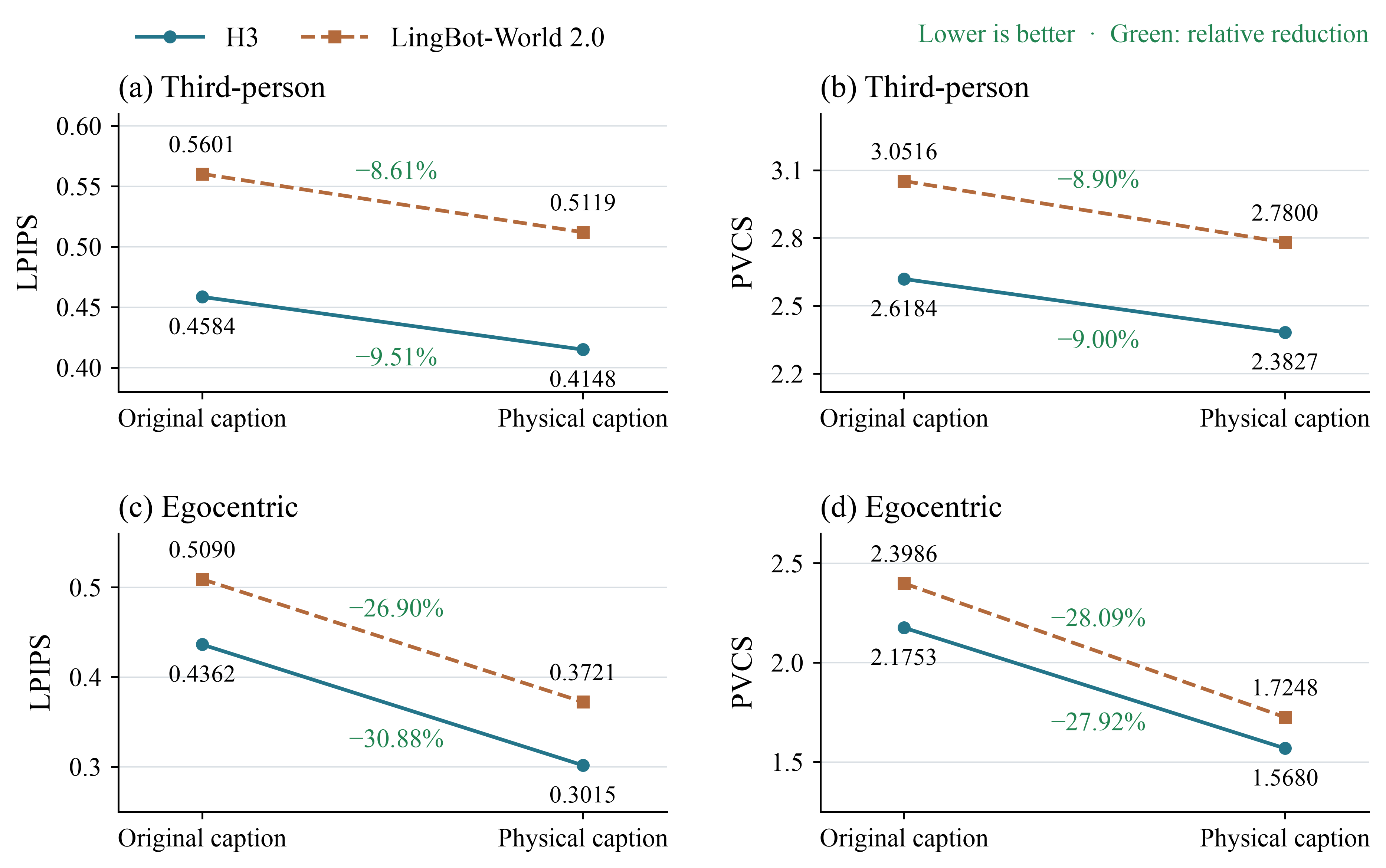
Matched source first frame and target duration; only caption conditioning changes. H3: 33B; LingBot-World 2.0: 14B. Reductions are relative to Meta. LPIPS and PVCS measure perceptual distance to the source, not physical accuracy.



Physical conditioning better retains localized debris and the drill bit separating from the workpiece.
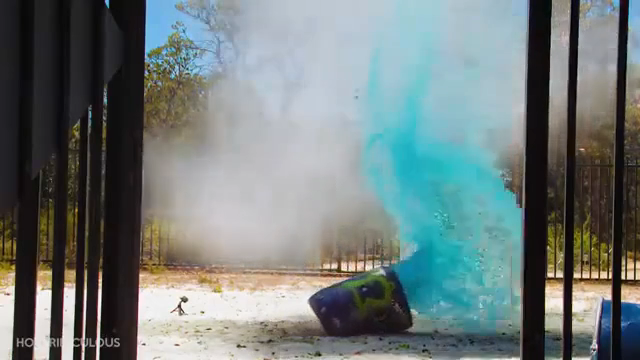
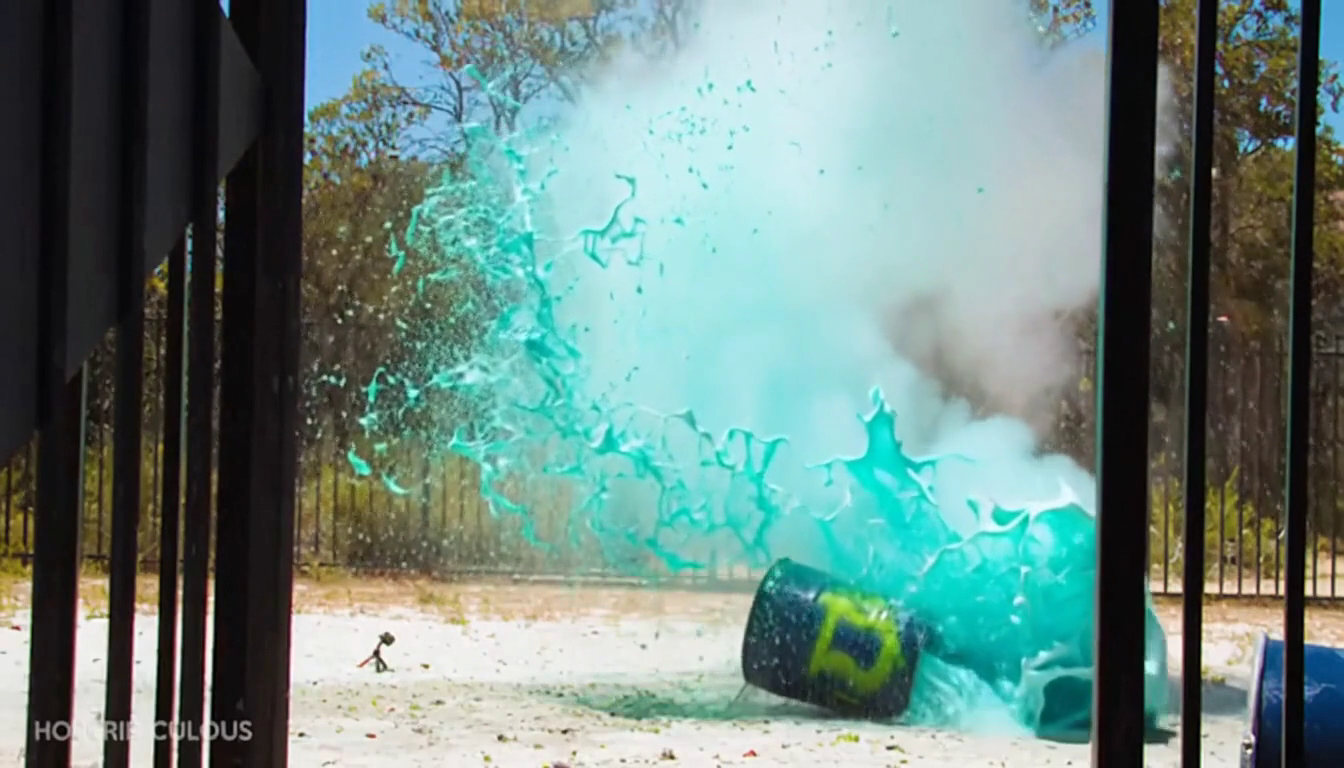
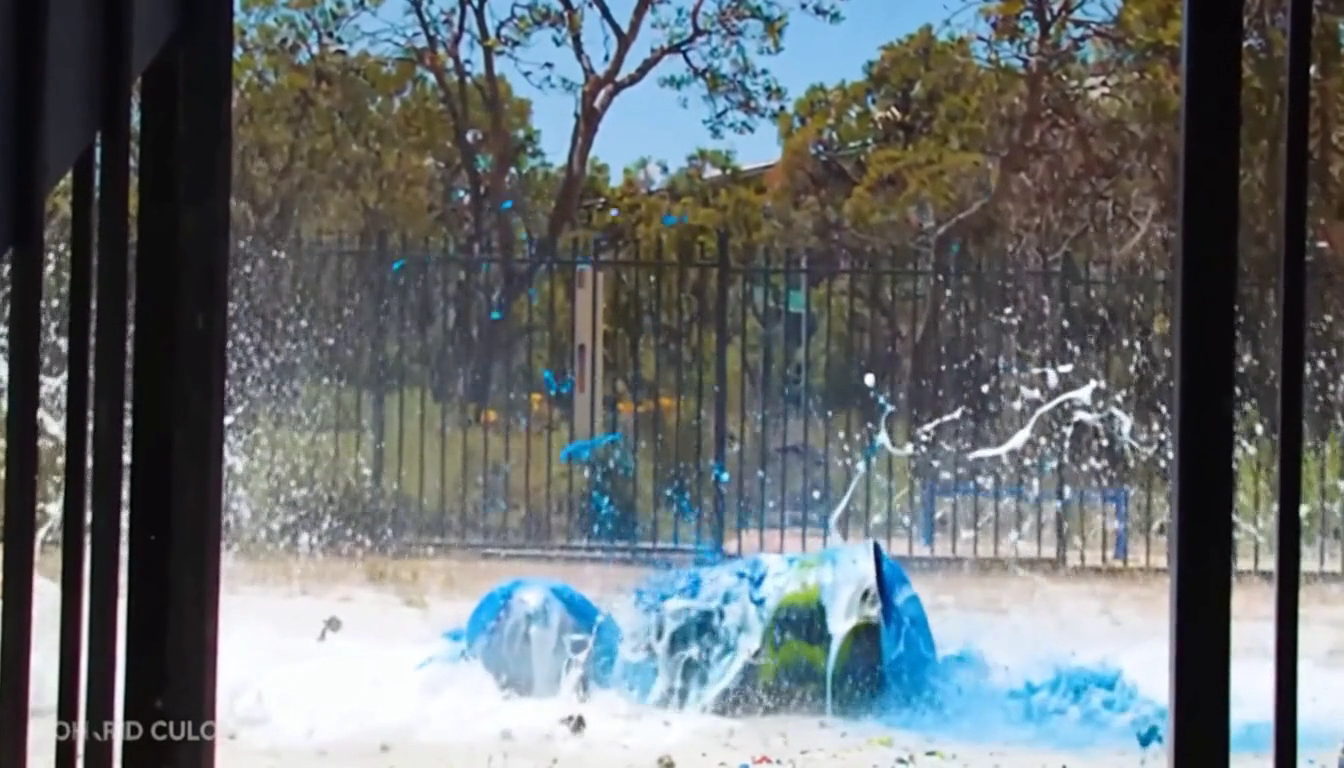
Physical conditioning better retains the persistent plume and the barrel tipping onto its side.
Physical instruction enrichment specifies the demonstrated sequence, acting gripper, target placement, and post-release state. The report tests both a controlled single-task comparison and four policy families across selected tasks.
| Benchmark | Original | Enriched | Gain |
|---|---|---|---|
| RoboTwin 2.0 | 27.27 | 69.44 | +42.17 |
| RoboDojo Sim | 34.68 | 73.26 | +38.58 |
| Held-out scenes | Raw | Enhanced | Gain (pp) |
|---|---|---|---|
| Standard · 20 scenes | 50.0 | 55.0 | +5.0 |
| Randomized · 20 scenes | 25.0 | 35.0 | +10.0 |
| Overall · 40 scenes | 37.5 | 45.0 | +7.5 |
Same 50 demonstrations, 23,098 frames, action targets, sampling indices, and training settings. 5,000 LoRA updates; batch size 32; training seed 0. Half of training indices receive enriched instructions. Both policies use the same original short instruction at execution time.
| Policy | RoboTwin baseline | Enriched | Gain (pp) | RoboDojo baseline | Enriched | Gain (pp) |
|---|---|---|---|---|---|---|
| π₀.₅ | 50.4 | 51.9 | +1.5 | 30.6 | 32.6 | +2.0 |
| X-VLA | 44.4 | 45.4 | +1.0 | 30.9 | 32.2 | +1.3 |
| GalaxeaVLA | 29.1 | 30.1 | +1.0 | 13.6 | 14.9 | +1.3 |
| starVLA | 23.5 | 24.0 | +0.5 | 13.7 | 14.3 | +0.6 |
Official baselines versus enriched-instruction policies in the report’s selected-task evaluation. These are task-subset means, not full-benchmark rankings. Gains are percentage-point differences between displayed values.
Use PhysCapBench to compare captioning strategies, diagnose omitted physical information, refine data construction, and connect description quality to downstream behavior.
Start with the evaluation code ↗Read the tech report and explore the code and dataset.